Look for the rooms behind the house
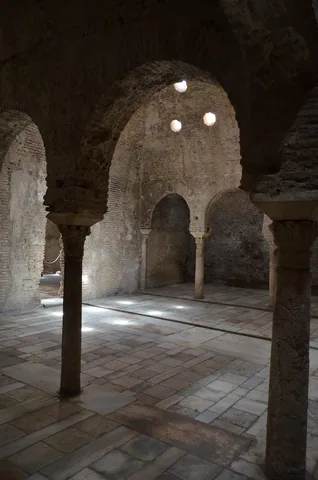
El Bañuelo is a historic public bathhouse on Granada's Carrera del Darro, in Spain. Its later domestic frontage can make it easy to miss. Behind that modest approach are vaulted rooms, columns and small openings that admit light through the roof.
The building is traditionally dated to the eleventh-century Zirid period, although researchers have also proposed a twelfth-century date. It belongs to Granada's medieval urban history before the great Nasrid palace works at the Alhambra. This was a public bath serving a neighbourhood, not a smaller room inside the royal complex.
If you enter, follow the changes between spaces rather than looking for a large bathing pool. The bathhouse used rooms with different temperatures. Its architecture supported a sequence of washing, warming and cooling, as well as time spent in company.
Light through a closed roof
The small ceiling openings are particularly useful details. Some have star or polygonal shapes. They let daylight into enclosed rooms while preserving a very different atmosphere from an open courtyard. As the light changes, the room's depth and the line of its arches become easier or harder to read.
Horseshoe arches rest on columns and capitals. These supports divide the space without turning every area into a completely separate chamber. Looking through more than one arch helps you understand the arrangement rather than treating a single decorated capital as the whole attraction.
The rooms once depended on heat and water. The surviving monument cannot reproduce the sounds, humidity or activity of a working bath, and it is not an operating spa today. The empty spaces show the structure that made those uses possible.
A part of ordinary city life
The bath's location near a busy route and historic gate mattered. Bathing belonged to the routines of an urban population, with social and religious meanings as well as hygiene. That context is different from imagining every Andalusi interior as a secluded royal retreat.
Later use as a laundry helped keep the structure in use after its original bathing function ended. The house above and the surviving rooms below show how an old building can remain within a changing city without keeping the same purpose.
The disagreement about the exact construction century is a useful limit on the story. You can recognise the room sequence, vaults and skylights without pretending that every part has a settled date. When you return to Carrera del Darro, compare the small public frontage with the volume behind it. El Bañuelo gives a view of Granada that the larger monuments on the hill cannot provide.