More than a beautiful room
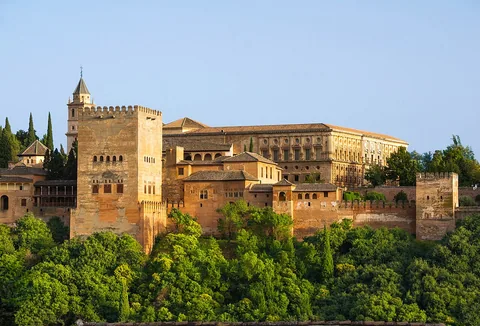
The Alhambra in Granada, Spain, was a fortified city built around a royal court. The Nasrid sultans lived here, but so did guards, officials and people whose work supported the household. Its walls enclose palaces, a military stronghold called the Alcazaba and the remains of a much larger working settlement.
The Nasrid dynasty developed the site from the thirteenth century. Many of its best-known palace spaces belong to the fourteenth-century rulers Yusuf I and Muhammad V. After the Christian conquest of Granada in 1492, the Alhambra continued as a royal site and acquired new buildings, including the Palace of Charles V.
Begin by separating those functions. A defensive tower, an audience room and a workshop served different needs. The Alhambra becomes easier to understand when you see how court ceremony depended on the less conspicuous places around it.
Who kept the court running?
The Alcazaba housed a military community, including homes and facilities for the guard. It occupied a strategic position, but its purpose also involved protecting the ruler and controlling access within the complex. The outer wall is only the beginning of the story of security.
The palatial district contained rooms for government, audiences and family life. Access became more restricted as spaces became more private. The surviving decorated courtyards did not all appear in one building campaign; rulers could alter predecessors' work as well as add their own.
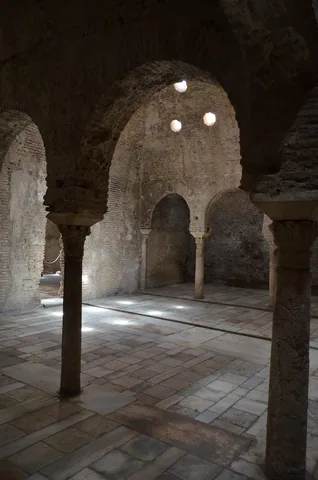
Elsewhere, the medina supplied an ordinary range of urban needs. It had houses, shops, a mosque and baths, alongside areas of craft production. Much of that fabric survives as archaeological evidence rather than complete rooms. Give those lower walls some attention: they help explain how an ambitious royal residence could operate every day.
Water and later rulers
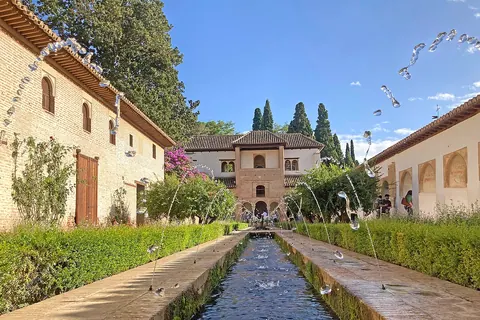
Water from the Darro reached the hill through the Acequia Real and a network of smaller channels. The same supply supported practical uses and the pools and fountains that shape a palace visit. Ornament required infrastructure.
The Renaissance Palace of Charles V is particularly useful for understanding the next phase. Its large classical forms occupy the same enclosure as Nasrid buildings, making the change in royal patronage visible. Continued occupation also helped determine what was maintained, adapted or lost.
You can read the walls from across the valley, but an interior visit has its own admission and timing arrangements. Check the Patronato's official information before planning around a particular palace slot. This guide explains the complex; it does not replace a ticket, a site map or the route instructions that apply on the day.