A temple with a misleading nickname
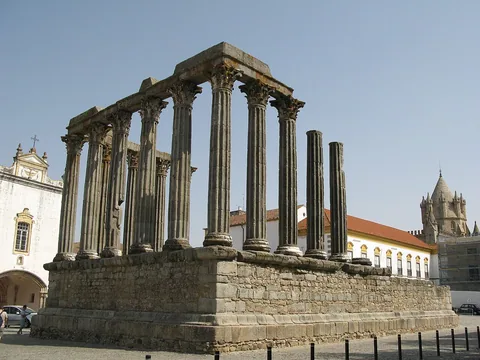
Évora's Roman Temple stands on a high stone platform near the top of the old city. It belonged to the Roman forum, the public centre of ancient Évora, and dates to the first century AD. The familiar name Temple of Diana came much later. The city's archaeological interpretation connects the building with the imperial cult, the religious honouring of Rome's emperors.
Look at the contrast between the heavy podium and the narrow, fluted columns above it. Their leafy Corinthian capitals give a relatively small surviving ruin a formal, ceremonial front. Much of the original building is missing, including its enclosed sacred room. What survives is enough to show how a temple could dominate a public square.
Those columns did not remain exposed throughout the intervening centuries. Later walls enclosed them, and the structure became useful for other purposes, including a municipal butcher's. Its survival involves adaptation as well as admiration.
The public space that has gone
Try looking beyond the columns to the room the temple once needed around it. A forum brought a city's public business into a planned setting. This was a prominent religious building within that setting, rather than a solitary monument planted among today's streets.
Archaeological investigation identified surrounding water features and a portico. The bare stone platform therefore gives only part of the original effect. Architecture, an organised open space and water worked together. You do not need to invent the missing colours or ceremonies to recognise how different this setting would have been from the present square.
The imperial cult also gives the temple a political meaning. Honour paid to an emperor connected local public life to the wider Roman state. A decorative capital and a high podium could help present that authority in a form people recognised across the empire.
A ruin revealed in the nineteenth century
The butcher's building challenges the idea that a monument survives only when people keep its original purpose. Enclosing the columns altered the temple, but it also kept old masonry in use. The later structure became part of Évora's everyday working city.
Nineteenth-century restoration removed those enclosing walls under Giuseppe Cinatti's direction. The freestanding columns familiar from photographs are therefore also the result of a decision about which period should be most visible.
From the public space around the monument, compare the regular spacing of the columns with the broken edges of the surviving structure. The repeated bays let you understand the order of the building; the gaps make its losses clear. Keeping both in view is more useful than treating the temple as a perfectly preserved Roman object.