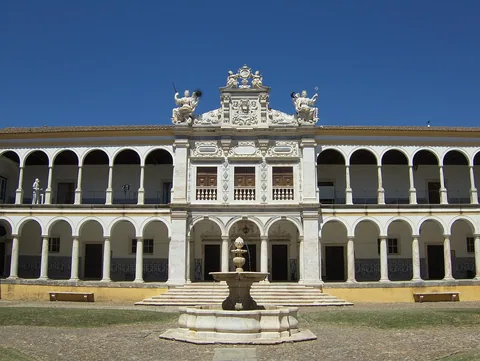
Begin with the two towers
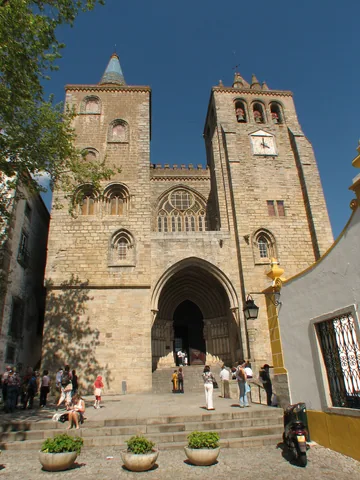
Évora Cathedral, dedicated to Saint Mary, occupies a high point in the Portuguese city's historic centre. Its twin stone towers and deep entrance give it a fortress-like appearance. The main medieval building combines Romanesque solidity with Gothic features. It was then altered by generations with different ideas about worship and decoration.
If you can see the main portal, look for the figures of the apostles lining the pointed entrance. Their presence changes the scale of the building. The broad facade can appear severe from a distance, but the doorway brings recognisable human figures into the approach.
Inside, where access permits, the later marble main chapel provides a useful comparison with the older nave. This is a cathedral with several architectural chapters, not an interior frozen when its medieval walls were finished.
Why it looks so solid
The building's thick stonework and strong towers help explain why descriptions often call it fortified. That appearance belongs to its architecture; it is not a reason to imagine every wall as a military defence. The pointed portal and its sculpture introduce another set of priorities: height, procession and the sacred meaning of an entrance.
The cathedral took shape over a long medieval campaign. Rather than making a single date carry the whole story, notice how forms associated with Romanesque building sit beside Gothic ones. The transition is visible in a structure whose builders had to make inherited walls and newer ambitions work together.
Above the roof, the central lantern is another identifying feature. From a distance it helps distinguish the cathedral from the many lower religious buildings in Évora. The skyline can be read before you enter any museum or chapel.
Marble at the far end
The eighteenth-century main chapel was designed by the architect known in Portugal as Ludovice, who also worked on Mafra. Its marble decoration belongs to a different world from the medieval entrance. Royal and ecclesiastical patrons could retain an old cathedral while changing the space that framed its main altar.
That does not make the later work an interruption to an otherwise complete medieval design. For the people using the cathedral, the altar remained a working religious centre. Updating its setting was a substantial act of patronage inside an established institution.
The cloister, museum and terrace add further ways to explore the site, but access to one part should not be assumed to include every other part. Check current arrangements before planning around the roof. Even from outside, comparing the carved portal, the two towers and the lantern gives you a clear beginning: each makes a different demand on your attention.