A room built for reflection
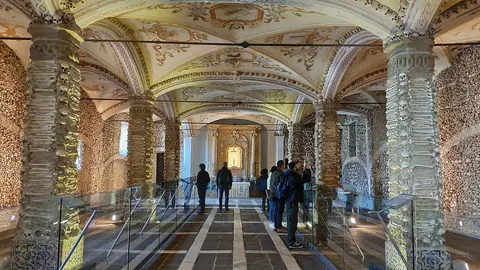
The Chapel of Bones is part of the São Francisco complex in Évora, Portugal. Its seventeenth-century builders covered walls and pillars with human bones and skulls from burial spaces associated with the convent. They intended the room to prompt reflection on the shortness of life and the obligations of Christian belief.
That purpose matters when you look at the carefully repeated rows of remains. The chapel was not assembled as a collection of unusual objects. Human bodies became part of a religious interior whose visitors were meant to think about their own mortality.
The bones can be upsetting, especially for children or anyone who finds human remains difficult to see. A photograph or this reading can still explain the place without making entry a requirement. If you visit, treat it as a space containing people's remains, within a church complex that continues to have a religious life.
Order rather than a heap
The repeated patterns are the first thing to examine once you have understood the subject. Pillars remain pillars, and walls remain walls, but their surfaces have been arranged from material that once belonged to living people. The room combines ordinary architectural order with an unusually direct statement about death.
Look above those surfaces too. The vaulted ceiling has painted decoration dated to 1810, including biblical references and symbols connected with Christ's Passion. The chapel's message therefore extends beyond the remains. Painting and Christian imagery provide the religious setting in which the bones were meant to be understood.
It is easy for a close photograph of skulls to remove that setting. A wider view, taking in the pillars and vaults, helps you see a composed chapel rather than a single alarming detail.
The larger church around it
São Francisco developed alongside the royal presence in Évora. Portuguese kings supported rebuilding the church as part of a complex linked with their palace. That helps explain the contrast between the ambitious church and the small room devoted to the end of earthly life.
The suppression of religious orders in 1834 brought decline to the convent buildings. The church and Chapel of Bones survived, supported by continuing devotion and local religious use. Later restoration belongs to that long history of keeping parts of the complex functioning as other parts changed.
The main church and the museum areas have different admission arrangements. This guide is a free reading, not a ticket. Before entering, check the church operator's current information, and allow the visit to be shorter or quieter than a normal monument stop if that suits you.