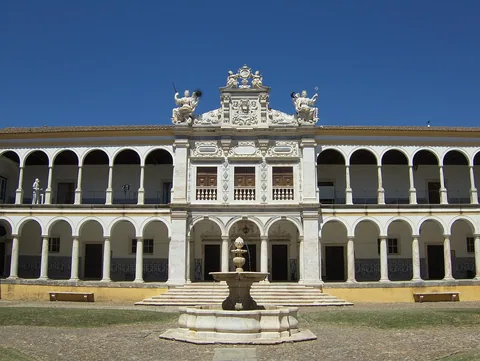
The college behind the courtyard
The Colégio do Espírito Santo is the historic home of the University of Évora in Portugal. Cardinal Henrique entrusted the college to the Jesuits, and papal authorisation established the university in 1559. The arcaded courtyard gives the institution a memorable public face, but the building's history includes changing rooms, new uses and a university that closed for more than two centuries.
The old university was shut in 1759 during the expulsion of the Jesuits. Higher education returned through the university institute created in 1973 and the modern University of Évora established in 1979. Those dates explain why the place can be both an old university building and part of a relatively recent institution.
If the courtyard is open to visitors, look at the repeated arches and the rooms arranged around them. This was built for people teaching and studying together, with circulation and gathering spaces as important as the ceremonial front.
What the founders could teach
The papal foundation did not give the new university an unrestricted remit. Its teaching rights excluded medicine, civil law and part of canon law. That detail makes the institution more specific than a general story about Renaissance learning: it had a religious order, a patron and a defined position within Portuguese education.
The Jesuits taught here for two hundred years. Rooms and functions changed as the college grew. University research describes a construction process extending over more than a century, with spaces adapted to practical and ceremonial needs rather than completed in one uniform campaign.
The courtyard can make the whole complex seem instantly ordered. Remembering the long building process helps you look past that first impression. The institution had to house lessons, public academic ceremonies and the other activities of an educational community.
Closure did not end teaching here
The suppression of the Jesuit university was a political act, not a gradual disappearance of interest in learning. The university's own history records troops surrounding the institution in 1759 and the removal of its teachers. The break was substantial.
Later schools occupied the building, including Évora's secondary school. Teaching continued in different forms before university education returned in the twentieth century. There is continuity in the use of rooms for learning, even though there was no uninterrupted university.
The present university is spread across several buildings in the city. This pin refers to the Colégio do Espírito Santo itself. It remains an educational setting, so visitor access may depend on current arrangements and academic activity. Check the university's visitor page before making a special trip for a particular room, and give classes and ceremonies priority while you explore.