A small church changes the usual beginning
St Martin's Church stands east of Canterbury's centre, beyond St Augustine's Abbey. Its scale is small, yet it changes how the city's Christian history is told. Queen Bertha was already worshipping here before Augustine arrived from Rome in 597.
That detail prevents a misleading beginning. Augustine's mission brought a new religious organisation to the Anglo-Saxon kingdom of Kent, but Christianity had a history in Britain before his arrival. St Martin's connects that wider story with a particular place and royal household.
The church remains in use for worship. Its long history is a history of adaptation as well as survival, so its present appearance should not be treated as a complete building frozen in the sixth century.
Read the mixture in the walls
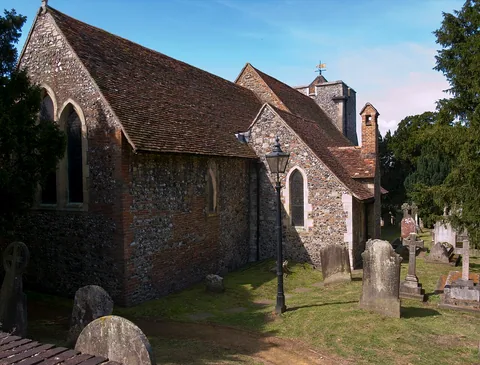
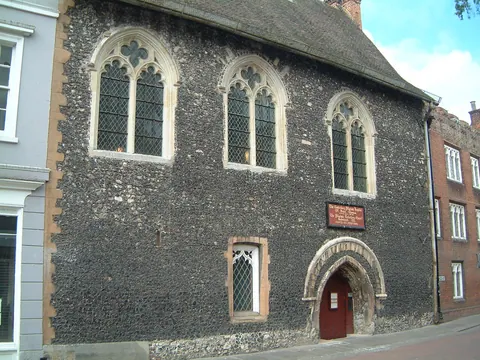
The exterior combines flint, Roman brick and rubble. These different materials make close looking rewarding. Long, thin bricks interrupt surfaces that otherwise appear irregular, while changes in masonry and openings show that the building was worked on at different times.
Roman material alone does not settle the date of every wall containing it. Older bricks could be retained or reused. The church's earliest construction has therefore required interpretation, rather than simply reading an age from each visible piece.
The tower belongs to a later medieval phase, and the church has other additions and alterations. Distinguishing those parts allows the surviving early fabric to matter without making every feature equally ancient.
Bertha's place in a larger story
Bertha was a Christian Frankish princess married to King Ethelberht of Kent. Her worship at St Martin's helps explain why Augustine's mission did not arrive in a setting with no connections to Christianity. Religious change involved relationships and existing practice as well as a recorded landing date.
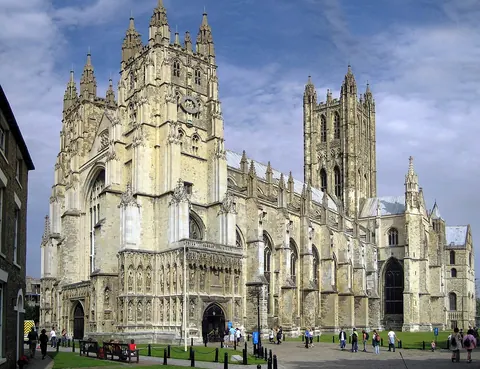
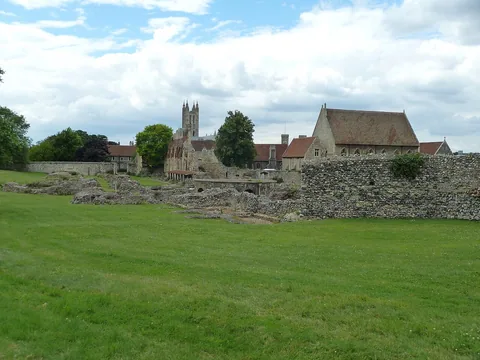
Compare the church with the abbey ruins nearby. The small place of worship and the later monastic complex served different communities and different scales of activity. The cathedral adds another institution, rather than replacing both stories with one enormous building.
If you visit, check the parish's current arrangements. Services and private events can affect entry. A quiet look at the exterior and churchyard still gives you a useful starting question: which parts preserve early use, and which show how later generations kept the place working?