The old-looking roof has two dates
Bath Abbey stands beside the Roman Baths, but its most useful story begins by looking up. Inside, spreading stone ribs form fans across the ceiling. The eastern vault belongs to the early sixteenth century. The nave continues that pattern in work made during the nineteenth century.
The apparent unity is deliberate. Victorian restorers used the older ceiling as a model, carrying its design through a much larger part of the church. A building can look consistent because later people worked hard to make it so.
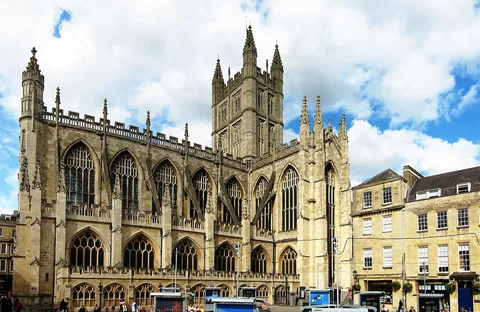
Outside, look for angels on ladders flanking the great west window. Their imagery links earth and heaven. The familiar story connecting them with a bishop's dream is a tradition about the rebuilding, rather than something the carvings can prove happened.
A church on top of earlier churches
Christian buildings occupied this place long before the present Abbey. King Edgar's coronation took place at the Saxon monastery here in 973. A later Norman cathedral was larger than the church that now stands beside the square.
By the late fifteenth century that cathedral was in poor condition. Bishop Oliver King supported a new building, begun around the turn of the sixteenth century. The angel ladders are associated with the story that a dream prompted his decision.
The scale changed, yet the place retained its religious role. Remembering the earlier buildings helps explain why a single date of foundation cannot describe everything you see.
The monastery closed before the story ended
The monastery was dissolved in 1539 during Henry VIII's suppression of religious houses. Its community dispersed and fittings were lost. The building's survival did not mean an uninterrupted life in the form its medieval patrons had intended.
Centuries later, George Gilbert Scott's restoration replaced the nave's timber ceiling with stone fan vaulting based on the older work to the east. The impressive roof is therefore evidence of two building campaigns with very different circumstances.
If you enter, trace the ribs until they gather into a fan. Then remember the gap between the people who made the original pattern and those who extended it. The Abbey remains a working church, so viewing its architecture must fit around worship and the day's access arrangements.