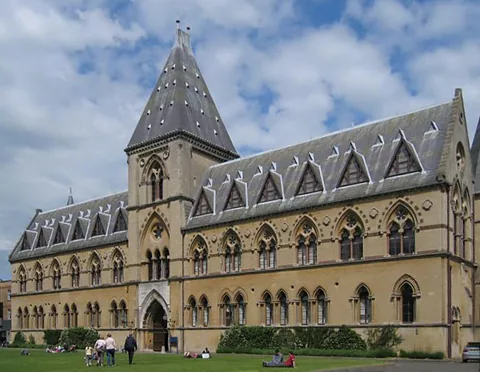
The columns belong in the collection too
Oxford University Museum of Natural History opened in 1860. Its Gothic exterior suggests an older architectural tradition, while the glass and iron roof inside belongs to the engineering possibilities of the nineteenth century. The building was designed for the study of nature, and its details take that purpose seriously.
Around the court, columns use different British decorative rocks. Plant forms appear in carved stone and ornamental ironwork. Even before you study a specimen, the structure asks you to notice materials and compare shapes.
Look at a column as something more than a support. Its stone and label turn part of the building into an object for observation.
Nature shaped stone and iron
The court's rock columns are labelled with their material and source. Above them, carved plants connect the architecture to botanical study. Masons sometimes worked from living examples brought from Oxford's Botanic Garden.
The roof required a less romantic kind of correction. Its first design could not carry its own weight and was taken down before completion. The replacement introduced the cast-iron columns visible today, with iron branches decorating the spaces above them.
The result joins ornament with engineering. The natural shapes do not hide the building's materials; they give you reasons to inspect them. Comparing a carved leaf, a rock surface and a branch in iron is a useful way to slow down in a room full of competing displays.
A famous debate needs careful retelling
On 30 June 1860, the newly opened museum hosted a discussion about Darwin's theory of evolution by natural selection. Thomas Huxley and Samuel Wilberforce, the Bishop of Oxford, became its best-known participants.
The discussion took place in a first-floor library room, not in a staged confrontation among the present displays. Nor is there an accurate complete transcript. Later retellings turned the exchange into a tidy contest with memorable insults and a clear winner; the surviving evidence is less simple.
That caution suits a museum devoted to examining evidence. The building, specimens and recorded history all reward a closer look. Rather than treating the debate as a single triumphant line, remember a new institution making space for arguments about how the natural world should be understood.