The library was rebuilt as a collection
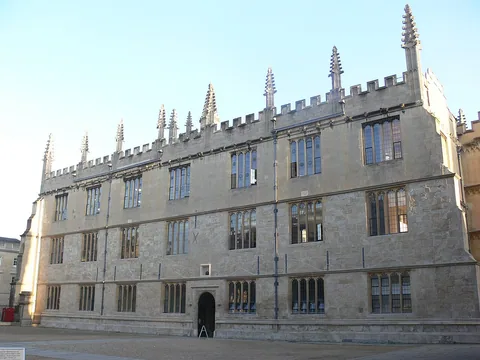
The Bodleian Library in Oxford opened to scholars in 1602, but its oldest room was already more than a century old. Duke Humfrey's Library had housed a medieval collection above the Divinity School. That collection was removed in the sixteenth century, leaving Thomas Bodley with a room to restore and shelves to fill.
This makes the Bodleian more than a story about preserving an old building. Its survival depended on rebuilding a collection and finding a way for it to keep growing. Later extensions answered a practical problem: where could Oxford put all the books?
The old complex still serves scholars. A visitor sees an institution with its own rules and working spaces, rather than a library that has become an empty architectural exhibit.
Teaching below, reading above
Duke Humfrey, the younger brother of Henry V, gave manuscripts to the university. A library built above the Divinity School opened in 1488 to house them. The arrangement brought a collection and a teaching space together without giving them the same room.
The Divinity School's elaborate stone ceiling belongs to a setting for teaching and examination. Above it, the library provided access to books. Thinking of the rooms by their jobs helps you understand why the complex is not simply one great hall.
In 1550, the medieval books were removed during religious reform. The room survived the loss of the collection it had been built to hold.
More books required more building
Thomas Bodley supported refurbishment and a new collection, with a librarian appointed before the 1602 opening. In 1610 he reached an agreement with London's Stationers' Company for books registered there to be deposited at Oxford.
That arrangement helped turn growth into a continuing responsibility. It was no longer enough to replace a lost collection once. Books would keep arriving, and the buildings had to respond. Extensions and the Schools Quadrangle formed part of that expanding complex.
If you visit, notice the relationship between enclosed reading rooms and the quadrangle outside. The stone architecture gives the library a public presence, while the collection relies on protected spaces where readers can work. Check the official options for a guided visit; a free written guide does not provide entry to those rooms.