The railway is bigger than its fastest engine
At York's National Railway Museum, a locomotive can be both a machine and the surviving part of a much larger system. Mallard's streamlined body makes that easy to forget. The blue A4 locomotive reached a recorded 126 miles per hour during a brake-test run in 1938, but speed required more than a powerful engine: a railway had to build, maintain, operate and measure the train.
Begin by comparing a vehicle with something smaller, such as a ticket, a sign or a piece of railway equipment. The vehicle tells you how people moved. The smaller object can reveal how their journeys were organised, who was allowed where, and what work made travel possible.
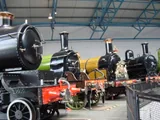
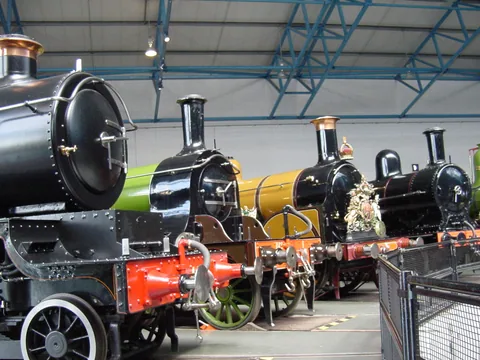
The museum itself occupies buildings adapted from railway use. Its Great Hall was a working motive power depot before becoming a public display space. That makes the setting part of the story. As you look around, keep one question in mind: what had to happen beyond the passenger's seat for this journey to work? It will lead you towards a richer visit than a list of famous engines.
Why a national collection came to York
The museum opened in 1975, as mainline steam was passing into history. Locomotives and rolling stock were being withdrawn, and preservation involved choices about what could be kept. York was selected after debate about where a national railway museum should be based.
The old depot offered a building suited to large vehicles. Its conversion brought together material from earlier collections, including the Science Museum's transport galleries and British Rail's heritage centre at Clapham. The result also moved a major national museum outside London.
That background changes the way to read a display hall. The collection is not a complete railway lifted out of one year. It contains things selected from different places and periods, often saved by people who recognised that everyday equipment was about to become historical evidence.
There is a practical limit to preservation. Museums cannot retain every vehicle, document or duplicate object. Choosing what survives shapes what later visitors can learn. An engine is an obvious candidate because of its size and engineering; a timetable or staff object may preserve a part of railway life that the engine cannot.
Mallard: notice how speed was made visible
Mallard was built at Doncaster in 1938 to Nigel Gresley's design for the London and North Eastern Railway. Its A4 form wraps the machinery in a streamlined outline. Look at the shape as an attempt to solve a problem, rather than as decoration added after the engineering.
The famous run took place on 3 July 1938 at Stoke Bank, between Grantham and Peterborough. The Science Museum Group's collection record explains that a dynamometer car measured the performance on paper rolls. A moving laboratory travelled with the train.
That measuring car is an important part of the story even when your attention is on Mallard. A speed claim becomes a record because somebody can demonstrate how it was measured. The achievement belongs to a working arrangement of locomotive, rolling stock, track, people and instruments.
From a safe viewing point, compare the smooth bodywork with the wheels and visible moving parts below it. The streamlined outline presents a fast passenger engine; the mechanism underneath still has to turn steam power into motion.
A passenger's railway and a worker's railway
The former goods station became Station Hall in 1990. The museum describes it as a setting for closer, more personal stories of passenger travel, contrasting with the broad view offered by Great Hall. Those are useful perspectives to carry through whichever galleries are accessible on your visit.
A passenger might think of departure time, luggage and a comfortable seat. The railway worker needed a different set of information. Vehicles had to be handled, maintained and placed where they were needed. Stations connected people with an operating system that continued beyond what any traveller could see.
Compare the inside and outside of a carriage if the display permits it. The passenger space is only part of the vehicle. Doors, steps and connections reveal the practical difficulty of moving people between platform and train. Different interiors can also make distinctions between kinds of travel visible without a long explanation.
Avoid assuming that every historic carriage is available to enter. Displays and access change. A closed doorway can still be a useful place to observe how the vehicle was arranged; it is not an invitation to cross a barrier for a better photograph.
The small objects keep the large ones honest
The National Railway Collection reaches from locomotives to uniform buttons. That range prevents railway history from becoming only a contest between engineers or a succession of speed records.
Find a modest object whose function is not immediately obvious. Before reading its label, work out what you can genuinely observe: its material, shape, markings and signs of use. Then compare your first explanation with the museum's. The difference shows how much knowledge a label can add to an apparently simple thing.
Paper is especially revealing. A ticket reduces a journey to permission to travel; a timetable reduces a complex pattern of movement to something a passenger can consult. Neither object is impressive in scale, yet both belong to the organisation that makes the railway useful.
If a named worker or passenger appears in the interpretation, give that account time. It can connect the technical system with a particular life. Keep their documented experience separate from the experience you imagine for someone else in the same period.
Let another country change the comparison
The museum's collection includes a Japanese 0-series Shinkansen power car. Its presence broadens the visit beyond British steam and offers a different answer to the problem of moving passengers quickly.
Compare its outline with an earlier locomotive if both are on display. You can notice how each presents the front of a fast train without claiming that appearance alone explains its performance. Labels can supply the operational and technological differences that a photograph cannot.
Railway history becomes more interesting when a new vehicle is treated as a response to particular needs, not as an inevitable upgrade waiting to happen. Different countries developed networks under different conditions. An international object is an opportunity to ask those questions rather than to rank every machine on a single scale.
Specific vehicles sometimes travel, undergo work or move between galleries. Plan around the museum's current display information if one object is essential to your visit. A collection guide should not be mistaken for a guarantee that every named vehicle is standing in a particular spot today.
Leave with one journey you can explain
Before you finish, return to a vehicle that caught your attention. Add two things you learned elsewhere: perhaps how performance was measured, how passengers found their way, or how equipment was preserved.
That vehicle should now have more people and processes around it. Mallard still has its remarkable record, but it also has an instrument car and a working railway. A carriage still has seats, but it also has boarding, luggage and different expectations of comfort.
 EXPLORE THE CITYYork city guideRead the city guide ↗
 🏰
🏰 🏰
🏰 🏰
🏰 🏰
🏰 🏰
🏰 🏰
🏰 🏛️
🏛️ 🏛️
🏛️ 🏛️
🏛️ 🏛️
🏛️