The Vikings beneath the shopping street
The most useful thing to know about JORVIK is that its story began beneath this part of York. Excavations at Coppergate uncovered timber buildings, leather shoes, workshop debris and the remains of meals. Wet, oxygen-poor ground had protected materials that usually rot away. Those discoveries made it possible to describe Viking York through ordinary lives, rather than only through raids and rulers.
The centre turns that evidence into an encounter with a reconstructed town. Keep two things separate as you visit: the objects and building remains that archaeologists recovered, and the modern decisions used to bring their world to life. Both matter, but they answer different questions.
A comb offers a good starting point. It is small enough to overlook beside a dramatic reconstruction, yet it connects the person who used it with the person who made it. At Coppergate, antler offcuts and unfinished pieces helped reveal that making process. This was a place of skilled work as well as a place to live. Follow that thread and the familiar image of a Viking changes: there is a workshop behind the warrior.
How redevelopment opened a window into Jorvik
Between 1976 and 1981, archaeologists investigated Coppergate ahead of major redevelopment. Modern building work created a limited opportunity to examine a much older city. The eventual visitor attraction grew from the ambition to make the discoveries understandable where they had been found.
Archaeology works by relationships as much as by individual treasures. A timber beside another timber can help define a building. Waste beside a workshop can suggest what happened there. A sequence of deposits can show change through time. Removing an object without recording those relationships would lose part of its meaning.
That is why the original excavation deserves attention alongside the finished displays. The Viking town was not waiting underground as a complete stage set. Archaeologists had to distinguish structures, record their positions and compare material from different layers. The public reconstruction is the result of that work, not a photograph of an intact settlement.
The centre opened in 1984. York Archaeology's account places it within a wider effort to conserve finds and share the city's past. If you have only seen York's medieval streets above ground, Coppergate adds another way to understand the city: some of its most revealing evidence came from what later generations built over.
Why a shoe can survive when a house disappears
York's damp ground was unusually kind to organic material. Without much oxygen, decay slowed, preserving wood, textiles and leather as well as environmental traces. The preservation was selective; it did not freeze every part of life equally.
Look at an organic object and consider what its survival allows researchers to ask. A leather shoe can give evidence about making and wear. Timber can help establish construction methods. Seeds and plant remains can contribute to an account of food and surroundings. The value often comes from combining these different kinds of evidence.
It also creates a responsibility. Something protected in buried ground may become vulnerable once excavated. Recovery and conservation are separate achievements. A find displayed safely today has passed through further work after the moment when someone first recognised it in the soil.
The objects are therefore more than props for the reconstructed setting. They are the reason that setting can be attempted at all. Give a worn or fragmentary object the same attention as a complete one; a broken thing can still carry a clear record of use.
Follow the comb back to its maker
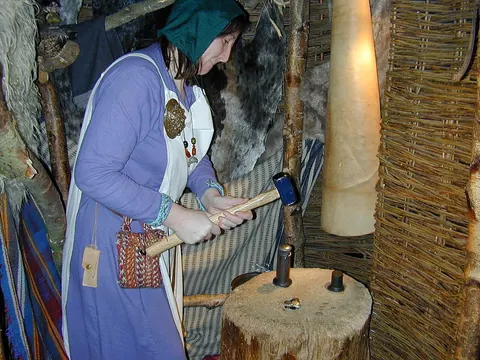
JORVIK's account of daily life describes evidence from different stages of comb production. Antler was worked into plates, held together with rivets, and cut into teeth. Decoration could turn a practical object into something carefully finished.
Try following the sequence in that direction: material, part, finished tool, user. It is a more precise way to imagine a workshop than assigning a name or a personality to an unknown craftsperson. The evidence can establish a process even when it cannot supply a biography.
The same approach works with other finds. Does an object represent something used here, something made here, or something brought here? Those possibilities are related, but they are not interchangeable. A town engaged in trade could contain goods from elsewhere alongside the waste of local production.
Coppergate's archaeology helped establish Jorvik as a commercial place. The useful contrast is between the wide connections of the town and the small scale of an individual working plot. Trade becomes tangible when you can relate it to a tool, a material or a task.
Enjoy the reconstruction without confusing it with a recording
A visitor experience has to make choices that an excavation cannot settle completely. Buildings need a finished appearance; people need positions; activity needs a sequence. These choices can make the evidence easier to grasp, but their vividness does not make every detail equally certain.
When a display feels particularly convincing, look for the explanation of what supports it. Is the claim tied to a find, a building footprint, environmental evidence or comparison with other sites?
That habit also keeps the attraction from reducing Viking York to a single afternoon. The excavations covered deposits accumulated over time. People rebuilt, discarded things and changed their surroundings. The reconstructed town presents a way into that history, rather than the only possible view of it.
Return to Coppergate with a different picture of York
The strongest souvenir from JORVIK may be an ordinary object you can still describe afterwards. A comb, a shoe or a piece of worked wood connects the grand category of the Viking Age to a recognisable activity.
Back outside, Coppergate belongs to another working city. Below it, timber and everyday waste preserved relationships that a surviving monument alone would never reveal: who made things, what they worked with, and how a town used its space.
 EXPLORE THE CITYYork city guideRead the city guide ↗
 🏰
🏰 🏰
🏰 🏰
🏰 🏰
🏰 🏰
🏰 🏰
🏰 🏛️
🏛️ 🏛️
🏛️ 🏛️
🏛️ 🏛️
🏛️