A small district with a public edge and private lives
Kazuemachi, also written Kazue-machi, is one of Kanazawa's three historic chaya districts. Beside the Asanogawa River, narrow lanes and lattice-fronted buildings give it a different scale from the more widely visited Higashi Chaya District nearby.
In this context, a chaya is a place of entertainment and hospitality associated with traditional performing arts, not simply a shop where anyone can order a cup of tea. Some premises remain private businesses with their own arrangements. A walk through the district does not include entry to them or a performance.
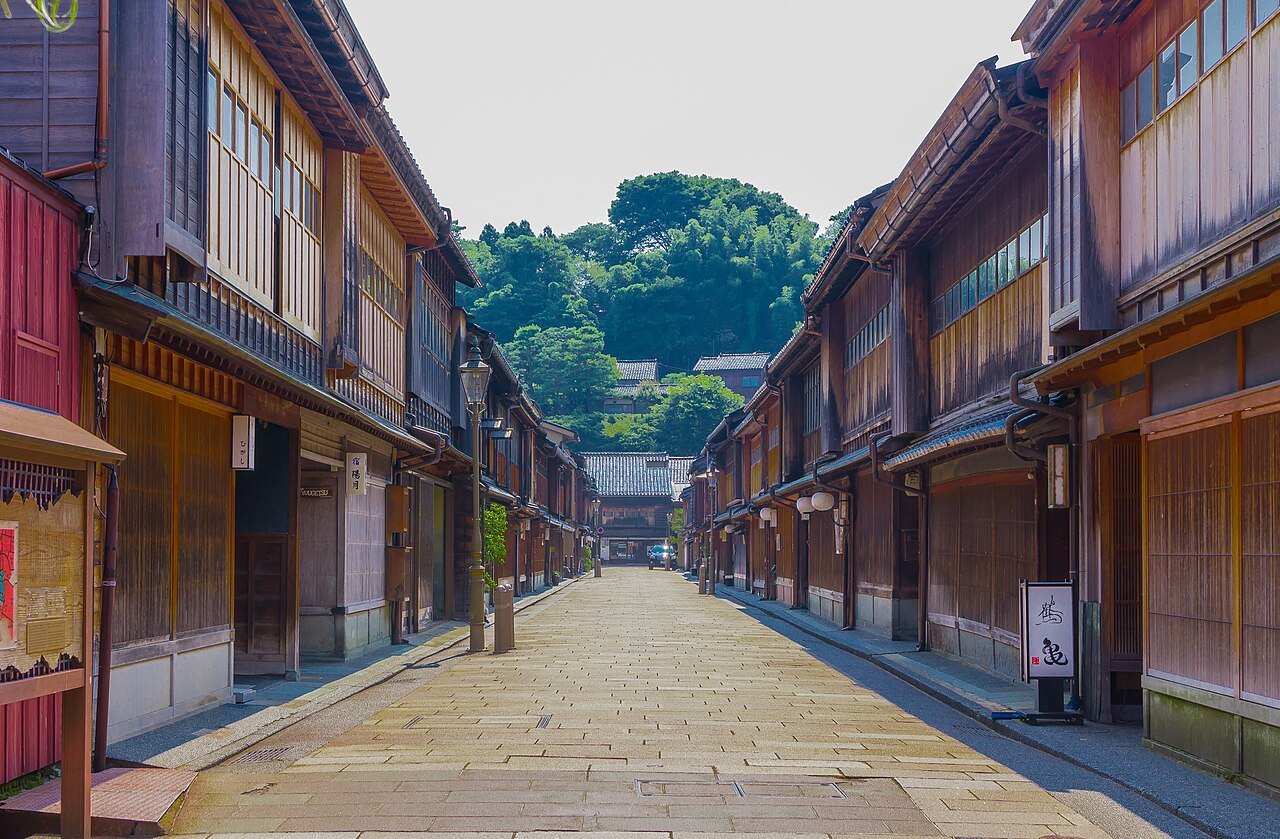
Begin with the relationship between riverfront and lane. One gives a broad view along a line of buildings; the other brings you close to thresholds and screened façades. The latticework lets a building have a presence on the street while protecting what happens within. That balance between display and privacy is a useful way to understand the district, and a practical reason to visit without peering into windows or turning a resident's doorway into a photo location.
What a chaya district actually offers
Kanazawa's official information groups Kazuemachi with Higashi and Nishi Chaya. The districts belong to an urban tradition of hospitality and performance, including music, dance and conversation.
The word teahouse can be misleading in English because it sounds like an ordinary café. Here, the historical and continuing form of entertainment is more specific. A business may serve known clients, arrange particular events or offer selected visitor experiences, but those conditions are not the same for every building.
That distinction improves an outdoor visit. You can appreciate the streetscape without treating closed doors as a failed attraction. Privacy is part of how the district functions, rather than an obstacle that a more determined traveller should overcome.
If you want a cultural performance, use a clearly advertised programme and its own booking information. Do not follow someone going to work in the hope of obtaining an unplanned encounter.
Follow the river, then turn into the smaller scale
The Asanogawa provides an open edge to the district. From a permitted riverside viewpoint, notice how the buildings form a frontage and how openings towards lanes interrupt it.
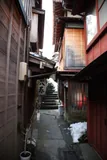
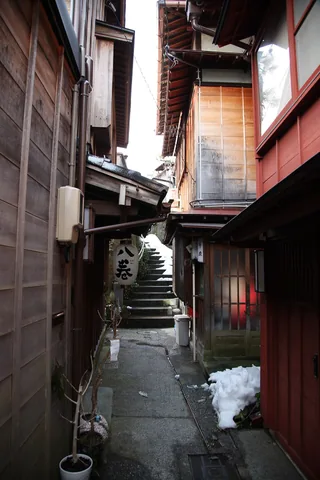
Then compare that view with a short walk into a public lane. The distance between façades narrows, and individual entrances become more prominent. You can see how the street's character depends on enclosure as much as on the age of its buildings.
The lattice fronts deserve close attention from a respectful distance. Their repeated lines can unify a façade while allowing a different relationship between the inside and outside than a plain wall would.
Modern uses belong to the scene too. A historic district continues through maintenance, business and domestic life. Its value does not require every sign or surface to look exactly as it did in the Edo period.
Bright and dark names give the lanes character
The official visitor description identifies Akari-zaka and Kuragari-zaka, commonly rendered as Bright Alley and Dark Alley. Their names give you memorable points of orientation within a compact area.
Look at what you can actually observe along a lane: its change in level, its enclosure and how it joins another street.
Kazuemachi also appears in the work of the Kanazawa-born writer Izumi Kyōka, whose museum is nearby. A district can belong to literary memory as well as architectural conservation. The link is an invitation to discover his writing, rather than a reason to invent a scene from a book you have not read.
The district's name is associated in official information with Tomita Kazue's Edo-period residence. That historical connection explains a place-name; it does not make all the surviving buildings the residence itself.
Preservation is a continuing use of the street
Kazuemachi is designated as a preservation district for traditional buildings. Such designation directs attention towards a group and its setting, rather than only towards one exceptional house.
That is visible in the experience of walking here. A line of façades, a lane and the riverfront work together. Removing one building from the setting would tell you less about the district than seeing how neighbours relate to one another.
Conservation does not mean that repairs and changes cease. It means that change takes place in a setting whose historic character matters. A well-maintained surface can be evidence of care, not evidence that the whole scene is a replica.
Keep the visit modest in scale. The district is small, and a thoughtful short walk can be more rewarding than repeated circuits in search of a perfect image. Leave space for residents, deliveries and other visitors.
Compare without collecting another version of the same photograph
If you also visit Higashi Chaya, compare the form of one lane or frontage. Kazuemachi's river relationship gives it a different experience even though both belong to the city's chaya history.
The useful memory is not that one is more authentic or that the quieter one is automatically better. Remember the buildings facing open water, a lane turning away from it, and a screen maintaining privacy at the edge of public space.
That memory explains why this small district deserves its own guide while remaining part of the wider story of Kanazawa's hospitality and performing arts.
 EXPLORE THE CITYKanazawa city guideRead the city guide ↗
 🌿
🌿 🌿
🌿 🌿
🌿 🌿
🌿 🌿
🌿 🌿
🌿 🏛️
🏛️ 🏛️
🏛️ 🏛️
🏛️ 🏛️
🏛️