A museum that leaves time to think
The D. T. Suzuki Museum introduces a writer and Buddhist thinker through a deliberately small arrangement of buildings and gardens. Daisetz Teitaro Suzuki was born in this part of Kanazawa in 1870 and became an influential interpreter of Buddhist thought for readers beyond Japan.
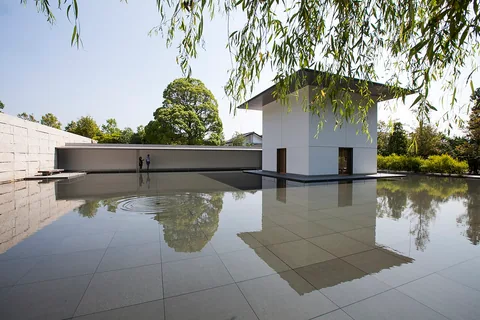
Architect Yoshio Taniguchi designed the museum around three wings and three gardens, including the Water Mirror Garden and a space for contemplation. The visit combines learning about Suzuki with time to consider what you have encountered.
You do not need prior knowledge of Zen to begin. Read one piece of interpretation carefully, then notice what happens to your attention when you move into a quieter architectural space. The water, walls and framed views give you something specific to observe. This is a museum opened in 2011, created to introduce his work and offer a setting for reflection; it is not his preserved home.
Suzuki's ideas travelled through language
Suzuki's life connected Japan with institutions and readers abroad. In 1897 he went to the United States and worked for the Open Court Publishing Company in Illinois, undertaking editorial and translation work. Later lectures and publications reached audiences in Europe and America.
Translation is a useful thread to carry into the museum. Making an idea available in another language involves more than replacing individual words. A reader also needs explanations, comparisons and choices about what to emphasise.
That makes Suzuki an interpreter, not a substitute for every Buddhist tradition or every practitioner. His books and public work belong to a particular life and historical setting. A visit becomes clearer when that influence is recognised without asking one writer to stand for an entire religion.
Look for a text, letter or biographical detail that shows the work involved in communicating across cultures. The museum's changing displays may offer different examples. One carefully understood item is enough to give the quieter spaces a connection with Suzuki's actual activity.
Three wings give the visit a rhythm
The museum identifies an Entrance Wing, an Exhibition Wing and a Contemplative Wing, connected by corridors. The arrangement moves between arrival, information and time for consideration.
The corridors deserve a moment too. Passing between rooms can make you aware of the change from reading to looking. An opening towards a garden may introduce something quite different from a case containing a document.
Taniguchi's design also sits within the landscape of the Honda-machi area. The museum describes gardens, stone walls, water and greenery against the rising ground. Notice where the architecture frames that setting and where it lets the setting continue beyond the immediate enclosure.
The Water Mirror Garden is something to observe
The garden's name gives you a simple starting point: reflection. Look at a boundary between a solid surface and the water, or at how the building appears in the pool. The view may change with light and movement.
Give the observation a little time before taking a photograph. Which part is the thing itself, which part is its reflected image, and what does the surface of the water make easier or harder to see? These are questions you can answer through looking, without turning the pool into an explanation of Zen.
The pool gives reflection a physical form, but it does not stand in for Suzuki's writing. The architecture leaves time to consider something encountered in the exhibition.
Follow the museum's quiet-use and access instructions. Other visitors may be using the same space for the purpose its name suggests, and the best way to share it may be to leave a little distance.
A few minutes without collecting more information
Museums often encourage us to move from one label to the next. This one explicitly allows another use of time. After looking at a display, you can pause without treating the pause as a gap that needs filling.
Try recalling a phrase or idea from the interpretation in your own words. If you cannot yet explain it, you can return to the display. If it raises a question, let that question remain open for the moment.
The museum is distinct from a temple or a formal meditation course. Check its current programme if you want an organised activity; ordinary admission should not be assumed to include instruction.
Connect the quiet museum with the city outside
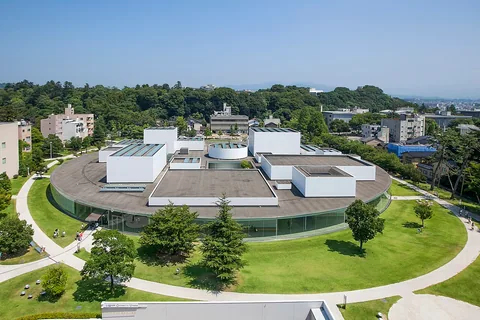
The 21st Century Museum of Contemporary Art offers a useful architectural comparison during a Kanazawa visit. One institution creates intimacy through a compact sequence of spaces; the other uses a low glass circle to encourage multiple approaches from the city.
The comparison does not require visiting both on the same day. It offers a question about what a cultural building asks its visitor to do. At Suzuki's museum, the opportunity to pause belongs to the programme as much as the display of objects does.
Before leaving, take one last look at an edge you noticed earlier: a wall against water, a doorway framing a garden, or a corridor opening towards greenery. You now have a connection between that physical detail and a museum designed to leave room for thought.
 EXPLORE THE CITYKanazawa city guideRead the city guide ↗
 🌿
🌿 🌿
🌿 🌿
🌿 🌿
🌿 🌿
🌿 🌿
🌿 🏛️
🏛️ 🏛️
🏛️ 🏛️
🏛️ 🏛️
🏛️