A dynasty begins with a family landscape
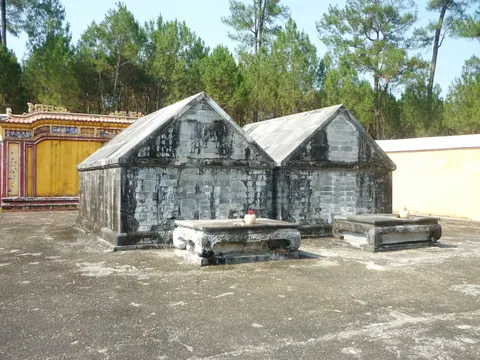
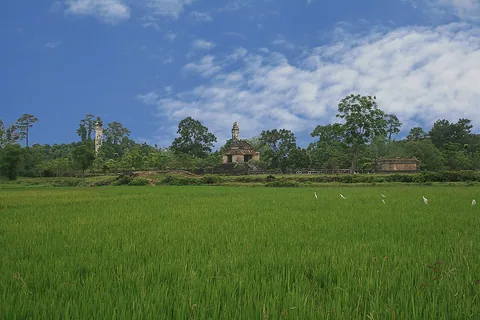
Gia Long Tomb, also called Thiên Thọ Lăng, commemorates the founder of the Nguyễn dynasty in a landscape of hills, water and related royal burials outside central Huế. Its most revealing feature is the pairing of Gia Long's grave with that of Empress Thừa Thiên, rather than an isolated imperial tomb.
Work began after the empress died in 1814 and continued into 1820. Gia Long took part in choosing and planning the site. The result belongs to a wider family burial landscape; the familiar attraction name should not lead you to expect one building containing the whole story.
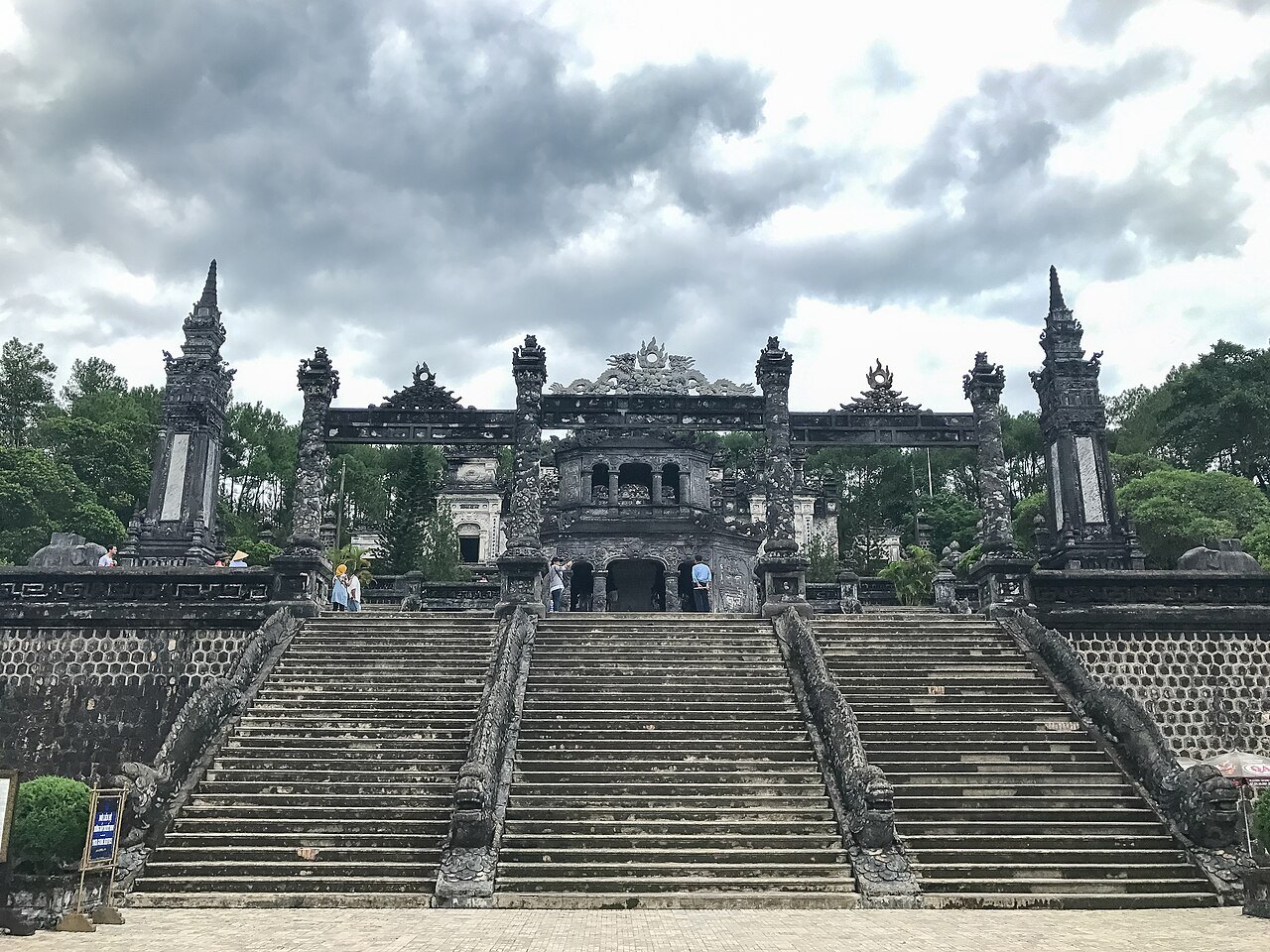
Give the setting as much attention as the stonework. Notice the relationship between the paired graves, the ceremonial approach and the surrounding ground. This is a way to understand how a new ruling dynasty placed its founder within a continuing family line. The site is separate from the central Citadel and needs its own journey and visitor planning. It rewards time spent reading the landscape, without requiring you to treat every hill as a symbol you can decode with certainty.
Why the empress belongs at the beginning
The construction history begins with Empress Thừa Thiên's death, rather than with a completed monument commissioned after Gia Long's own burial. That order matters. The site developed while the emperor was alive and involved decisions about his family's remembrance.
Gia Long established Nguyễn rule with Huế as the imperial capital in the early nineteenth century. A founder's burial place could connect the new court with ancestors and descendants, giving a ruling house a physical setting beyond the buildings of government.
The paired graves make that family connection direct. The empress's place beside the emperor can be seen in the arrangement itself.
When an account describes the tomb simply as belonging to the emperor, remember the empress's part in its origin. Her burial is not a minor detail added to his story; it helps explain why the complex began here in the first place.
The terrain is part of what you came to see
In a landscape tomb, the spaces between built features matter. A courtyard, a change in level or a view across water can organise the approach as strongly as an elaborate façade. Look along a visible line of movement and then turn to see how it relates to the surrounding hills.
Traditional siting gave terrain and orientation a role in the design. The hills and water belong to the composition, even where their specific historical interpretation needs further explanation.
There is a practical consequence too. Distances that look modest on a photograph may take longer on foot because the site extends across open ground. The building you notice first is not necessarily the whole visit, and a map pin is not a substitute for the current visitor entrance.
Follow the paths between the built features and look back occasionally. A turn in the route can bring the relationship between the tomb and its hills into view.
A grave and a place of worship do different work
The burial area and buildings used for remembrance have related but distinct purposes. One marks the location of the dead; another supports the actions through which descendants and the court remembered them.
Recognising that distinction makes a royal tomb complex easier to read. A hall need not contain a coffin to be central to the visit. Its importance may lie in commemorative use, while the grave occupies a different part of the grounds.
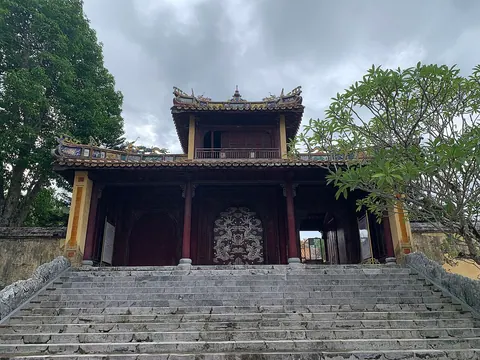
If a building is closed or used for an observance, there is still much to understand from its relationship with the approach and burial area. Do not assume that the guide includes interior access or that a ceremonial threshold can be crossed for a photograph.
The family tombs around the principal burial also change the scale of the story. This is not only an emperor's monument viewed from the capital; it is part of a larger place of dynastic burial. Specific identities should come from the site's labels rather than guesses based on proximity.
Compare the founder's tomb with a later one
If you also visit Minh Mạng Tomb, focus on one difference rather than trying to memorise a sequence of reigns. Compare how the approach is organised and how strongly a central line directs movement. At Gia Long, let the broader terrain remain visible in your explanation.
That comparison is useful because Huế's royal tombs are often sold as interchangeable stops. They belong to the same dynasty, but their plans and histories deserve separate attention. Visiting more tombs is only worthwhile if each adds something you can recognise.
What stays with you
Return to the paired graves in your mind before leaving. The arrangement gives the large subject of dynastic foundation a specific form: two burials, a family landscape and a set of decisions made while a new imperial order was taking shape.
The surrounding hills are no longer simply a picturesque background. They are part of the scale at which the tomb was conceived. That is the most useful way to carry Gia Long Tomb into the rest of a Huế visit: as a distinct approach to remembrance, rather than another royal name added to a checklist.
 EXPLORE THE CITYHuế city guideRead the city guide ↗
 🏯
🏯 🏯
🏯 🏯
🏯 🏯
🏯 🏯
🏯 🏯
🏯 🏯
🏯 🏯
🏯 🏯
🏯 🧺
🧺