Twelve courtyards, many different jobs
Palacio de Viana is famous for twelve courtyards and a garden, but the number is less useful than the differences between them. A reception courtyard presents status. A service courtyard helps a household work. A barred opening can show a garden to the street while keeping the house private.
The palace grew through the acquisition and adaptation of neighbouring houses over centuries. Its present arrangement is therefore a history of expansion and changing domestic life, rather than twelve matching patios designed at once.
Choose three contrasting spaces instead of trying to rank all twelve. Notice how you enter each one, what rooms it serves and whether it opens towards the street or into the house. Flowers and water deserve attention, but so do working routes and thresholds. Viana becomes much more memorable when its courtyards are understood as spaces used by different people, not simply as beautiful backgrounds for photographs.
A palace assembled from adjoining properties
Viana's history reaches back to a group of late medieval houses. Successive owners bought neighbouring property, changed entrances and extended the complex. An important expansion in 1814 added spaces now occupied by several courtyards and the garden.
This explains why the plan can feel like a sequence of discoveries. You are moving through an accumulated property, not a completely symmetrical palace conceived on an empty site. A change of direction may reflect the boundaries and uses of an earlier house.
The palace's historical account also identifies owners who reshaped the presentation of particular areas. Domestic architecture here was a way to organise a household and to make the family's social position visible.
The property opened to the public in 1981 after its acquisition with the collections. Public access created another chapter in its history. The Courtyard of the Columns, added in 1983 for cultural and institutional activity, is a useful reminder that the familiar total includes a modern contribution.
Reception begins before the drawing room
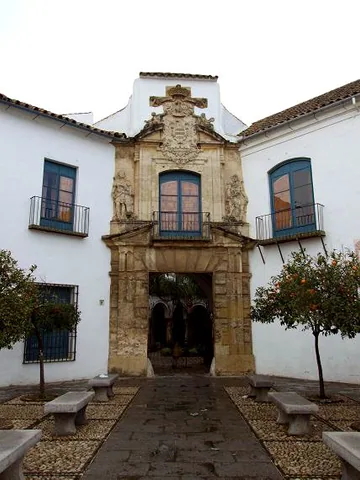
The Reception Courtyard was part of a major change to the entrance and access to the stables. Its role was practical, but it also gave arriving visitors an impression of the house and its owners.
Look at the difference between entering from the street and reaching a more enclosed interior space. A courtyard can provide light and room to circulate while controlling what a visitor sees next.
The Courtyard of the Bars offers another relationship with the outside. The palace's own history connects the seventeenth-century façade there with a desire to show the family's position. From a public street, a barred view can reveal part of the garden without making the whole house accessible.
If you can compare the view from outside with the view from within, notice what each allows. One presents a scene; the other places you inside the circulation of the house. The same architecture serves two different observers.
The working courtyards keep the household in view
The palace's visitor plan distinguishes working, gardened, monumental and more intimate courtyard types. Names such as the Courtyard of the Well, the Pool and the Gardeners point towards activities as well as decoration.
Use the names as prompts, then look for supporting evidence. A water feature may be ornamental, useful or both. The current garden presentation should not automatically be taken as a complete picture of historical work.
The Courtyard of the Cats has roots in a group of neighbouring houses that became part of the larger property. That history brings ordinary housing into a palace visit. Expansion could absorb a different kind of domestic space and give it a new relationship with the surrounding rooms.
Water, planting and a large household required continuing care. Look for how a service courtyard connects with the rest of the house: its position helps explain how work supported the more formal rooms.
Follow one view through an opening
Viana's official plan calls attention to several framed views: a fountain beyond an arch, one courtyard seen from a window, and rooms that align the view of different patios. These are good ways to slow down without trying to memorise every space.
Choose an opening and notice how much of the next area it reveals. Then move through it, where access permits, and compare the new view with the one you had before. A garden can feel much larger or more intimate depending on that sequence.
This exercise also keeps the architecture visible when planting is especially attractive. The frame, path and surrounding rooms help create what you are enjoying. A patio is a relationship between built enclosure and open air, rather than a garden detached from the house.
Seasonal changes alter the balance between plants and architecture. When flowering plants are less prominent, an arch or line of rooms may become easier to follow.
Viana and Córdoba's patio festival are related, but different
Córdoba's courtyard tradition includes private homes, religious and aristocratic buildings, and spaces opened through the annual festival. Viana offers a concentrated visit to one accumulated house-palace. It should not be presented as the whole tradition in miniature.
The festival depends on participating owners and its own dates and arrangements. Viana has separate admission and visitor information. A ticket or opening at one does not imply access to the other.
The distinction is also useful historically. A palace courtyard and a smaller shared domestic patio can answer similar needs for light and open space while reflecting very different resources and social arrangements.
Leave with functions, not a score of twelve
Recall three courtyards by what they did. One received visitors, one related the house to the street, and another served the daily work of the property. Add a framed view you can picture clearly.
Those memories explain more than a complete count. Viana's achievement is the variety gathered within one growing property, and the way its successive occupants made open space part of domestic life. The flowers are still there, but now the house around them has people and purposes again.
 EXPLORE THE CITYCórdoba city guideRead the city guide ↗
 🏛️
🏛️ 🏛️
🏛️ 🏛️
🏛️ 🏛️
🏛️ 🏛️
🏛️ 🏛️
🏛️ 🏛️
🏛️ 🏛️
🏛️ 🏛️
🏛️ 🏛️
🏛️